

Step out of the Luxor sun and into a realm where time itself holds its breath. The Valley of the Kings is no mere collection of ancient graves; it is a silent, sun-scorched amphitheater chosen by a civilization that conversed with eternity. For nearly 500 years, this secluded canyon on the Nile’s west bank became the secret gateway to the afterlife for the New Kingdom’s pharaohs, queens, and nobles. Forget the monumental pyramids that broadcast their presence across the desert; this was a place of concealed majesty, where the true treasure was not stone, but story, painted in colors that still blaze with life across the millennia.
From Towering Pyramids to Secret Tombs
The question that echoes off the limestone cliffs is, “Why here?” To answer this, we must journey back to the end of an era. The great pyramids of Giza and Saqqara, magnificent though they were, acted as colossal beacons for tomb robbers. By the time of the New Kingdom (c. 1550 BCE), it was clear that visibility was a vulnerability. A new strategy was born from a blend of pragmatism and profound theology. Professor Hisham often reminds us that the pharaoh’s journey to the afterlife was the single most important event, and its security was paramount. The Theban Necropolis offered the perfect solution: a remote, desolate wadi, guarded by a natural pyramid-shaped peak, al-Qurn, which the ancients saw as a sacred and protective symbol.
This was more than a change of address; it was a philosophical evolution. The focus shifted from the external, monumental structure to the internal, magical-religious narrative. The tomb itself became the vessel for resurrection. Its corridors and chambers were meticulously designed to be a microcosm of the underworld, with walls serving as an illustrated map and spellbook for the king’s perilous journey. Texts like the Amduat and the Book of Gates, previously reserved for scrolls, were now emblazoned directly onto the walls, creating an immersive, eternal guide for the deceased’s soul as it navigated the trials of the night to be reborn with the morning sun. This sacred valley was not a cemetery; it was a womb for gods.
Descending into Sacred Silence
As you approach the Valley, the clamor of the modern world recedes, replaced by a profound silence that seems to emanate from the very stones. Karim, our guide, often asks visitors to pause here, to feel the dry desert wind and gaze at the stark, imposing cliffs. He says, “This is the silence of three thousand years of secrets.” The heat is a physical presence, but the moment you cross the threshold of a tomb and begin your descent down the long, sloping corridor, the world transforms. The temperature drops, the air grows still and cool, and your eyes adjust to the soft light, revealing the first strokes of ochre, cobalt, and malachite. This transition is a deliberate piece of architectural theatre, designed to transport you from the world of the living (the hot, bright East Bank) to the realm of the gods (the cool, dark West Bank).
A Canvas of Power Art and Immortality
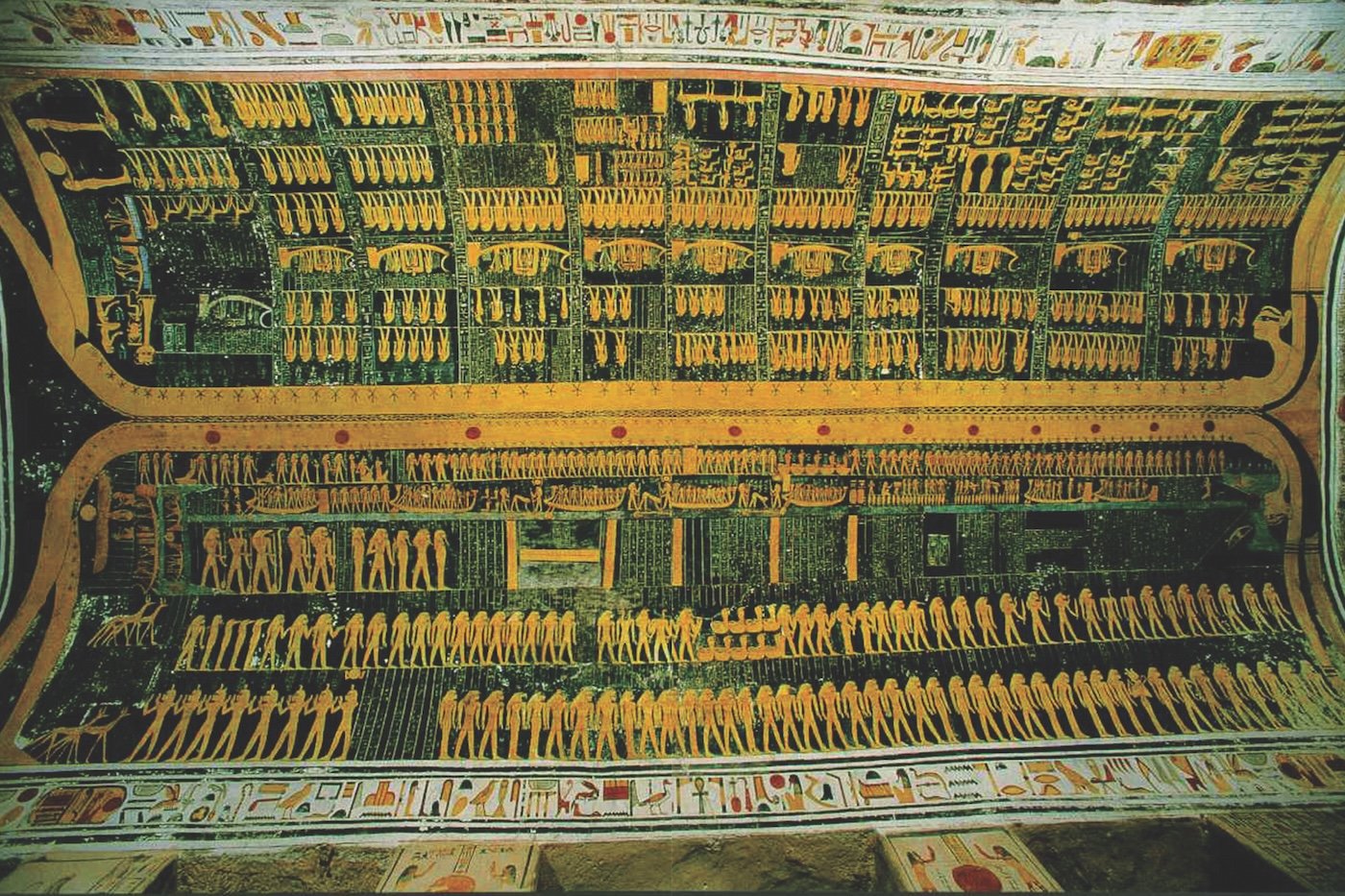
While over 60 tombs have been discovered, a visit is about quality, not quantity. Ahmed, our manager, always recommends a curated experience that reveals the Valley’s diverse artistry. The tomb of Ramesses VI (KV9) is a masterclass in cosmic narrative. As you enter, you are enveloped by a complete, painted copy of the Book of Gates and the Book of Caverns. But the true spectacle is the astronomical ceiling of the burial chamber. In a stunning display of celestial vibrancy, the goddess Nut arches over the entire scene, her body a tapestry of stars, swallowing the sun in the evening only to give birth to it again at dawn. It’s not just decoration; it’s a dynamic, cyclical engine of rebirth, painted above the pharaoh to ensure his own resurrection.
For sheer artistic finesse, the tomb of Seti I (KV17) is legendary. Often called the ‘Sistine Chapel of Ancient Egypt,’ its walls feature exquisitely delicate raised reliefs, a far more complex and time-consuming technique than the sunken reliefs seen elsewhere. Here, the figures of gods and pharaohs possess a subtle, lifelike quality, their forms seemingly emerging from the stone itself. The colors are so astonishingly well-preserved that they appear to have been painted only yesterday. Professor Hisham points out that this tomb contains the first complete version of the Litany of Ra, a powerful hymn invoking the 75 names of the sun god. To stand in this tomb is to witness the absolute zenith of New Kingdom artistic achievement.
How a Boy King’s Tomb Changed History
No story of the Valley is complete without the tale of Tutankhamun (KV62). For centuries, he was a minor, almost forgotten pharaoh. But in 1922, after years of relentless searching, the British archaeologist Howard Carter stumbled upon an intact step. The excitement was palpable. When his patron, Lord Carnarvon, asked, “Can you see anything?” Carter uttered the immortal words, “Yes, wonderful things.” What made this discovery so seismic was not the wealth of gold, but the fact that it was a complete, undisturbed royal burial. For the first time, the world saw not just an empty chamber, but the full panoply of objects a pharaoh believed he needed for the afterlife: chariots, furniture, games, and the iconic golden death mask.

Karim loves to tell this part of the story with a dramatic whisper. “Imagine,” he says, “the air of the 3,200-year-old tomb rushing out to greet them. They were the first to breathe it since the priests sealed the door.” The tomb is surprisingly small, its decorations more rushed than those of Seti I or Ramesses VI, likely due to Tutankhamun’s unexpected and early death. Yet, its impact was immeasurable. It triggered a global wave of ‘Egyptomania’ and provided an unparalleled, tangible link to the world of the pharaohs, transforming our understanding of ancient Egyptian ritual and royalty forever.
Insider Tips for an Unforgettable Visit
To truly commune with the Valley, you must approach it with intention. Leo advises against a rushed, box-ticking tour. “The magic here reveals itself slowly,” he says. His primary piece of advice is to arrive at the opening hour. The early morning light is ethereal, the temperatures are merciful, and for a precious hour, you can experience the tombs with a fraction of the crowds, allowing the sacred silence to work its spell. Alternatively, a late afternoon visit can also be quieter as day-trippers depart. Your standard ticket grants access to three tombs of your choice from a rotating roster, but Ahmed insists that investing in a supplementary ticket for a showcase tomb like Seti I or Ramesses VI is essential for any serious visitor.
Hydration is not a suggestion; it is a command. The sun in the Valley is relentless, and there is little shade. Wear a hat, and carry more water than you think you will need. Most importantly, hire a knowledgeable guide. The paintings on the walls are not merely beautiful pictures; they are a complex lexicon of theology, mythology, and royal ideology. Without an expert like Karim to decipher the symbols, translate the narratives, and connect the scenes to the broader arc of Egyptian belief, you are only seeing half the story. A guide transforms you from a tourist into a time traveler, unlocking the secrets that lie hidden in plain sight on every wall. This is how a simple visit becomes a profound pilgrimage.